


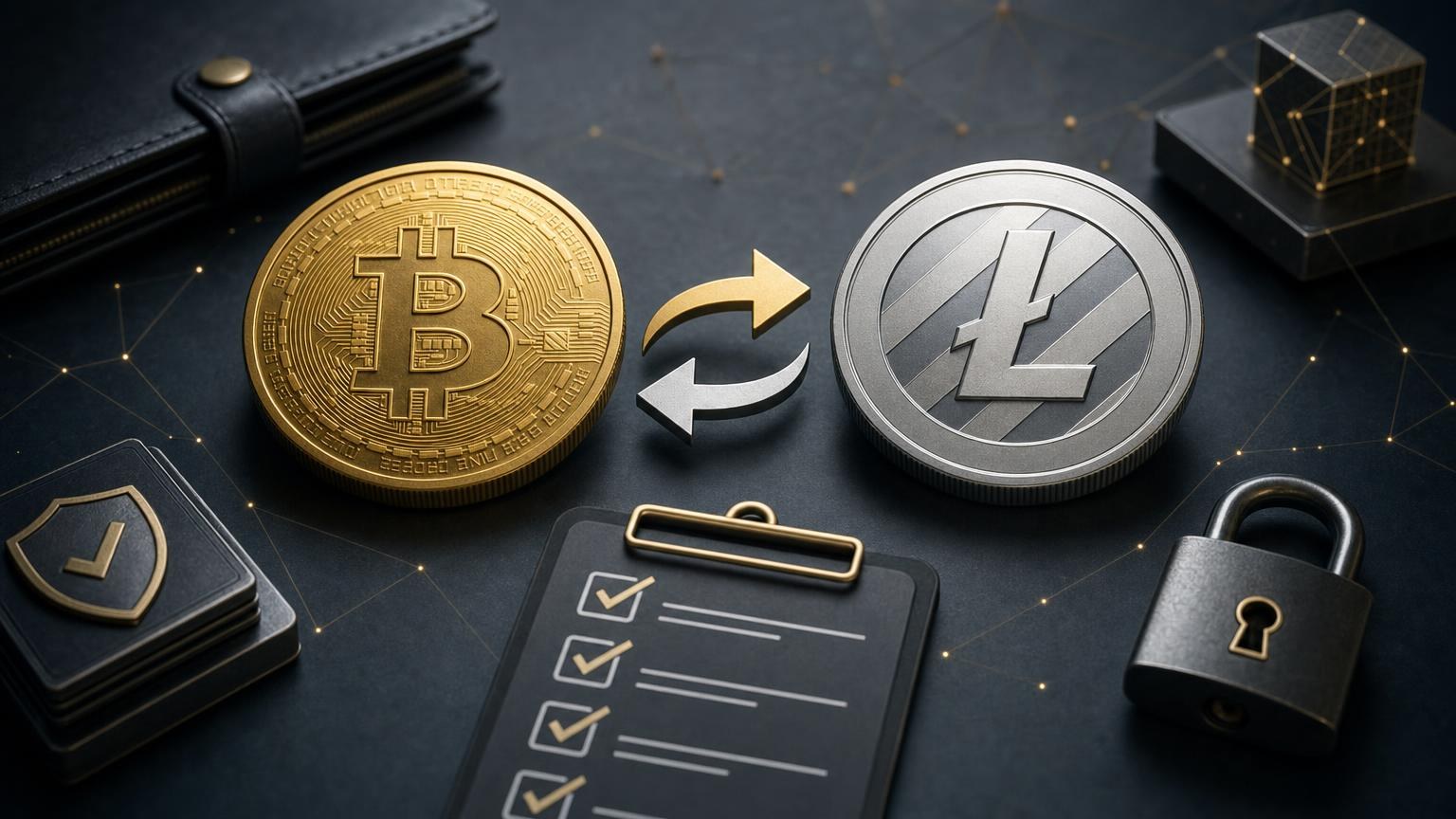
Exchanging Bitcoin for Litecoin involves two separate transfers: BTC goes from your wallet to the exchange deposit address, and LTC is sent to the receiving address you provide. Before creating an order, confirm that the BTC-to-LTC direction is currently available, prepare a Litecoin address you control, and decide what result you expect. These checks reduce the risk of sending funds through the wrong network, accepting an unsuitable quote, or losing track of a delayed transaction.
The BTC-to-LTC operation state map
The route below works as both an overview and a decision tree. Do not move to the next state until the condition and the visible evidence match.
- Task: define the intended result.
- Transition condition: you want to send BTC and receive native LTC in a wallet or account that supports Litecoin.
- Check: the destination wallet displays Litecoin as the selected asset and can generate an LTC receiving address.
- Stop if it does not match: the destination expects another asset, a token representing Litecoin on a different network, or a deposit method you cannot identify.
- Input data: prepare the sending and receiving sides.
- Transition condition: your BTC is available for withdrawal, and you have copied a fresh LTC receiving address from the intended destination.
- Check: the sending wallet identifies the asset as BTC, while the receiving wallet identifies the destination as LTC on the Litecoin network.
- Stop if it does not match: the BTC is on a platform that restricts withdrawals, the LTC address came from an unverified message, or the destination network is unclear.
- Availability check: verify the exchange direction and current conditions.
- Transition condition: BTC can currently be selected as the asset to send and LTC as the asset to receive.
- Check: the order interface shows BTC → LTC, the accepted deposit network, the receiving network, applicable limits, quote terms, and any verification requirements.
- Stop if it does not match: the pair or required network is unavailable, your amount is outside the displayed limits, or the requested compliance information cannot be provided accurately.
- Order review: inspect the address, amount, and cost.
- Transition condition: the LTC address passes the service’s format check and the displayed terms are acceptable.
- Check: compare the first and last characters of the address with the original, review the estimated or stated LTC output, and identify which fees are included or charged separately.
- Stop if it does not match: the pasted address changes unexpectedly, an unknown Memo or Tag is requested, the total is unclear, or the route no longer produces native LTC at the intended destination.
- Action: create the order and obtain the BTC deposit details.
- Transition condition: all terms have been reviewed and the order displays a BTC deposit address for this specific transaction.
- Check: save the order identifier, deposit address, required BTC amount, validity conditions, and status page details before leaving the page.
- Stop if it does not match: the page domain appears suspicious, the deposit details arrive only through an unsolicited message, or the address shown in your wallet differs from the order address.
- Irreversible step: send BTC.
- Transition condition: your wallet is using the Bitcoin network and the order is still active under its displayed conditions.
- Check: perform a final character comparison, verify the BTC amount, review the wallet’s network fee, and make sure the resulting total debit is affordable.
- Stop if it does not match: the wallet proposes another network, the order has expired or changed, the address cannot be verified, or the amount would arrive below a displayed minimum after relevant deductions.
- Waiting state: follow the BTC deposit and exchange status.
- Transition condition: the wallet reports that the BTC transaction was broadcast and provides a transaction ID.
- Check: confirm that the transaction appears on the Bitcoin network, pays the correct deposit address, and begins receiving confirmations. A transaction with zero confirmations has been broadcast but is not yet included in a block. [1]
- Stop and diagnose if it does not match: no transaction ID exists, the transaction pays a different address, it disappears from the wallet, or the service does not recognize it after the expected network evidence appears.
- Confirmed result: verify the LTC payout.
- Transition condition: the order reports completion and provides an LTC payout transaction ID.
- Check: independently inspect the Litecoin transaction, confirm that its output matches your receiving address, and wait until the destination wallet credits it under its own confirmation policy. Litecoin Core transaction data includes fields for the destination output, block hash, and confirmation count. [2]
- Stop and use the recovery path if it does not match: the order is marked complete without a traceable payout, the LTC went to another address, or the receiving platform requires information that was not provided during order creation.
Choose the asset and network before entering an address
The exchange direction should be displayed as BTC to LTC: BTC is the asset you send, and LTC is the asset you receive. Do not rely on a ticker alone if the wallet also offers tokens issued on third-party networks. The intended result for this route is Litecoin recorded on the native Litecoin blockchain.
On the sending side, use the Bitcoin deposit network specified by the order. On the receiving side, obtain the address by opening Litecoin in the destination wallet and selecting its receive function. An address generated for Bitcoin, another cryptocurrency, a test network, or a wrapped asset does not become suitable merely because a form accepts pasted text.
Litecoin supports more than one address format, so appearance alone is not enough to prove that an address is appropriate for a particular service or wallet. The order interface and the receiving wallet must both recognize the same Litecoin destination. If the service rejects the address, do not try to work around the check by manually changing its prefix or characters.
Availability must be checked when the order is created. BTC and LTC are supported assets, but that does not mean every pair, network, amount, or direction is continuously available. Temporary restrictions, maintenance, liquidity conditions, or compliance checks may affect the route.
Verify the LTC address and any Memo or Tag field
Copy the receiving address directly from the wallet or account where the LTC should arrive. Compare it after pasting because clipboard malware can replace cryptocurrency addresses. Checking only the first few characters is insufficient; compare characters at both ends and, where practical, several in the middle. A QR code can reduce typing errors, but the decoded address still needs to be reviewed on the signing device.
A standard LTC transfer is directed to a Litecoin address. Do not invent a Memo, Tag, payment ID, or other reference if the receiving wallet did not provide one. If a custodial destination explicitly supplies both an address and an additional identifier, copy both exactly as shown and make sure the order supports that requirement. If the exchange form has no place for a required identifier, stop before sending BTC and clarify whether the destination can credit the deposit without it.
The last safe moment to correct the LTC address is before submitting the order. The last safe moment to correct the BTC deposit address or amount is before approving the transfer in your wallet. Blockchain transfers should be treated as irreversible once broadcast; support may be able to investigate some mistakes, but investigation does not guarantee recovery.
Review the output amount, quote conditions, and fees
Focus on the amount of LTC expected at the destination rather than looking at the displayed rate in isolation. The order should make clear whether the output is fixed under stated conditions or may be recalculated before execution. If the quote has a validity period, confirm that you can send the BTC while the order remains valid. Do not assume that an expired order will be processed under the original terms.
Several costs may affect the result:
- Bitcoin network fee: charged by the sending wallet for broadcasting the BTC transaction. This can change the total deducted from your BTC balance.
- Exchange-related charge or rate adjustment: review whatever the order actually displays rather than assuming a standard percentage.
- Litecoin payout fee: if one applies, determine whether it is already reflected in the stated amount to receive.
- Destination charge: a custodial wallet or platform may apply its own crediting or deposit rules independently of the exchange.
Because fees, limits, and quotes are dynamic, no universal amount can be stated in advance. Check the live order details immediately before creation. Also review any identity or source-of-funds requirements shown for the transaction. Verification conditions can depend on the exchange direction and the outcome of compliance checks.
If the pair is available, the destination details are verified, and the displayed conditions fit the task, the practical next step is to open the BTC-to-LTC exchange form and review the current order terms.
Control points before sending BTC
Pause at these points because the next action may be difficult or impossible to reverse:
- Before creating the order: confirm that you need LTC, not another asset with a similar name or a token on another network.
- Before submitting the LTC address: confirm that you control the destination or understand the receiving platform’s crediting rules.
- Before approving the BTC transfer: verify the deposit address on the wallet’s final confirmation screen, not only on the exchange page.
- Before choosing a network fee: review whether the wallet warns that the fee may delay confirmation. Do not infer a guaranteed completion time from an estimate.
- After broadcasting: save the BTC transaction ID and keep the order identifier available until the LTC payout is confirmed.
The route no longer matches the original task if the order asks you to send an asset other than BTC, proposes a payout other than native LTC, displays a network unsupported by your wallet, or requires a destination identifier that cannot be entered. It also stops matching if a third party tells you to ignore the active order and send funds to a replacement address through chat, email, or social media. Such changes are a common phishing warning sign.
How confirmations affect the waiting stage
Broadcasting a BTC transaction does not mean the deposit is final. First, the transaction enters the network; then it can be included in a block and accumulate confirmations. Bitcoin’s developer documentation distinguishes an unconfirmed broadcast from a transaction included in a block and explains that confidence increases as additional blocks are added. [1]
The exchange decides how many confirmations it requires before processing a deposit. The destination wallet separately decides when to credit the LTC payout. These policies may differ, so the BTC transfer can be confirmed in your wallet while the order still shows a waiting state. Likewise, the exchange may mark the payout as sent before the destination makes the LTC available.
Use transaction IDs as evidence. A wallet status such as “sent” is useful, but a public network record lets you verify the destination, amount, block inclusion, and confirmations independently. Bitcoin transactions can be tracked by transaction ID, although technical cases such as transaction replacement may affect how a wallet presents the record. [3]
Diagnosing a delayed or incorrect transaction
The BTC transaction has no transaction ID
The wallet may not have broadcast the transfer. Check whether it shows a failed, pending approval, queued, or unsigned state. Do not send a second payment merely because the first one is not visible in the exchange order. A duplicate transfer can create a separate deposit that requires its own investigation.
The transaction exists but has no confirmations
Verify that the transaction is visible on the Bitcoin network and that the output pays the exact order deposit address. An unconfirmed transaction may be waiting for inclusion in a block. The sending wallet may show whether it supports a fee adjustment or another transaction-management function, but do not use such a function without understanding whether it preserves the intended payment. Keep the original and any replacement transaction IDs.
The BTC is confirmed, but the order has not detected it
Compare the on-chain amount and deposit address with the saved order details. Check whether the payment arrived after an order validity condition, differed from the requested amount, or was sent through an unsupported route. Contact support through the service’s verified interface and provide the order identifier and BTC transaction ID. Never provide a seed phrase, wallet private key, or remote access to your device.
The order shows processing for longer than expected
Avoid relying on a generic time estimate. Confirm the latest state shown on the order page and check whether additional verification has been requested. Processing can depend on network confirmations, route availability, compliance review, and payout conditions. Repeatedly creating new orders does not resolve an existing deposit and can make record-keeping harder.
The service reports an LTC payout, but the wallet shows no balance
Inspect the payout transaction using its LTC transaction ID. Confirm that the output address matches the one submitted in the order and review its confirmation count. If the transaction is confirmed at the correct address, the remaining issue may be the destination wallet’s synchronization or crediting policy. Litecoin transactions are recorded on the Litecoin blockchain, where outputs and confirmations can be checked independently. [2]
An incorrect address or network was used
Stop sending additional funds. Preserve the order details, transaction IDs, wallet screenshots, and exact addresses. Report the error through an official support channel, describing what was sent and which network was used. Recovery may be technically impossible or may depend on who controls the destination keys; no return of funds should be assumed or promised.
What counts as a completed BTC-to-LTC route
The route is complete when the BTC deposit is traceable to the order address, the order has a final completed status, the LTC payout transaction points to the address you supplied, and the destination wallet credits the expected LTC under its confirmation policy. Keep the identifiers until all four conditions can be checked.
Some uncertainty may remain before completion: network fees can change, confirmations can take longer than an interface estimate, the final output may depend on the quote terms, and compliance review may require additional information. These are reasons to read the live order conditions rather than rely on a general description. A clear pair, matching networks, verified addresses, saved transaction IDs, and independently observable confirmations provide the strongest evidence that the exchange followed the intended route.